



AI at Work 2025: New Trends and Application Methods
By karmaX Expert
 10 min read
Updated 12:00 AM GMT+7, Mon November 25, 2025
Artificial Intelligence has moved from hype to habit. Across industries, companies are no longer experimenting — they are embedding AI into daily workflows. A report by IBM (2025) notes that organizations identifying as “AI-first” are redefining competition itself, building faster decision systems and unlocking exponential productivity. Rather than asking “What can AI replace?”, leading firms now ask “How can AI empower?”

In practice, employees increasingly rely on AI assistants trained on enterprise data to perform everyday tasks: summarizing reports, analyzing campaigns, or answering natural-language queries like “What was last month’s ad spend in Korea?” These tools make data accessible, reduce manual effort, and amplify human intelligence.
Automation and Augmentation in Action
The most visible shift is the automation of repetitive work. From finance to HR, AI models now process invoices, screen resumes, and review contracts — freeing humans to focus on higher-value problem solving. IBM (2025) reports that its own use of automation and AI unlocked over 4.5 billion USD in productivity gains, largely by integrating AI into operational decision points.
But the new wave of AI is not just automation — it’s augmentation. Marketing teams use AI to generate creative drafts; sales teams use predictive analytics to forecast conversions; HR teams deploy conversational bots to onboard employees or answer policy questions. Each instance turns data into foresight and speed.
Smarter Decisions, Powered by Data
AI-driven analytics is transforming how organizations make decisions. Predictive models embedded into dashboards now simulate “what-if” scenarios, identify risk, and surface new opportunities. According to IBM (2025), decision-intelligence systems can increase planning efficiency by up to 30 %.
Applying AI not only to execution but also to insight generation. Imagine combining generative AI’s speed with your team’s strategic thinking — turning raw market data into narratives, foresight, and recommendations for clients faster than ever before.
Humans and AI: The New Collaboration Model
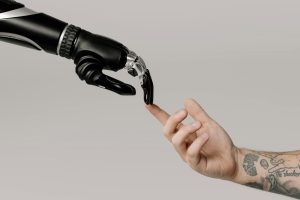
As automation accelerates, a parallel trend is clear: upskilling. The future of work is not AI versus humans — it’s AI + humans. Studies (ArXiv, 2025) show that demand for higher-order cognitive and creative skills is rising precisely in the areas where AI is most used.
Forward-thinking companies are building “AI academies,” offering internal training in prompt design, ethical use, and data literacy. Others create hybrid roles where business specialists collaborate directly with AI engineers. The shift is cultural as much as technical — recognizing that AI doesn’t replace judgment, empathy, or creativity, but enhances them.
Responsible and Measurable AI
With adoption comes accountability. Governance, security, and ethics have become central concerns. IBM (2025) found that 83 % of Chief Data Officers believe AI’s benefits outweigh its risks, yet most still lack mature frameworks to scale responsibly. In Hong Kong, 88 % of companies use AI tools, but more than half have no clear governance policy (Human Resources Online, 2025).
To use AI responsibly, organizations are establishing transparent guidelines: defining approved tools, training data sources, and human review processes. Measuring ROI is also critical. Companies now benchmark AI by cost reduction, decision speed, and customer satisfaction — ensuring that innovation translates into measurable value.
Implications for Communication & Marketing Teams
For creative and consulting firms, these trends open tangible opportunities. AI can assist in drafting thought-leadership content, analyzing market data, generating visual concepts, and automating repetitive project management. Predictive analytics can support campaign testing and audience segmentation, while generative tools accelerate content production across languages and formats. However, the competitive edge will not come from using AI faster — but from using it more intelligently and ethically, combining human context with machine capability.
AI in the workplace is no longer a futuristic concept; it is the new infrastructure of productivity. The next leap is not about automating tasks, but augmenting people. As IBM (2025) highlights, true transformation happens when organizations redesign work itself — letting AI handle the routine so humans can focus on strategy, empathy, and innovation.
The challenge and opportunity lie in this balance: to harness AI as both a creative partner and a strategic advantage.


